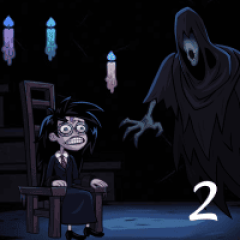
Eloquent Countenance is a wonderful horror game with visual novel and adventure elements. Play as a nun and make wise choices to determine your fate.
Rather than relying on a large open world or constant combat, it places its attention on a tightly focused narrative. You follow Angelica through a suspicious funeral service, encounter an unfamiliar supernatural presence, and make decisions that affect the direction of the story. The central conflict begins with an unusual assignment. Angelica has already helped the church with the funeral of the pastor's wife not long ago. Now, after hearing that the pastor has suddenly passed away, she is selected to assist with his funeral service as well. However, the ceremony does not proceed as expected. Just as Angelica is preparing to begin her duties, a strange voice enters her thoughts. The voice claims to be a guardian angel and offers instructions about how she should behave during the service. This encounter changes the meaning of everything that follows. Angelica is no longer simply helping the church complete a funeral. She is caught in a situation where the people around her may know more than they are willing to reveal.
The relationship between Angelica and Forcas is essential to understanding Eloquent Countenance. Their personalities and conflicting perspectives shape the game's dialogue, atmosphere, and central decision-making system.
Angelica is the protagonist of Eloquent Countenance.
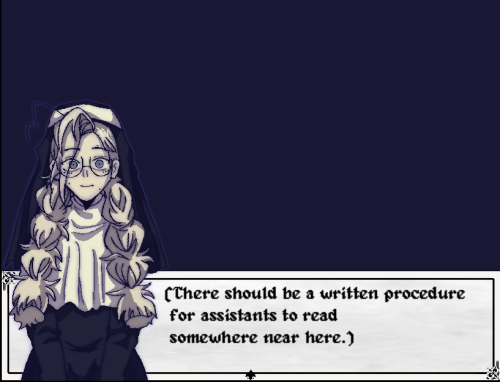
Figure 1: Angelica
She is presented as a young woman, presumably in her early twenties, with pale skin and very long platinum-blonde hair. Because of its considerable length, she keeps her hair arranged in two loose bubble braids. Her appearance contrasts with the increasingly disturbing circumstances surrounding her. Angelica begins the story as someone carrying out an assigned responsibility, but she soon finds herself facing questions that challenge her understanding of the church and her own identity. An important part of her characterization is that her personality is influenced by your choices. Her independent dialogue suggests that she tries her best and takes her responsibilities seriously. However, the way she responds to other people depends on how you guide her through the funeral.
Forcas is the second major character and the supernatural figure who approaches Angelica during the funeral.
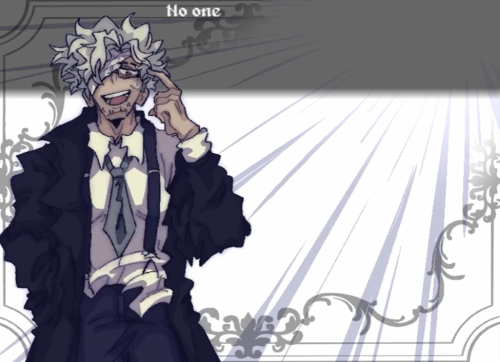
Figure 2: Forcas
He introduces himself as a guardian angel from Heaven and claims that he wants to guide her through the events taking place. His appearance is unusual for a character associated with Heaven. Forcas looks like a middle-aged man with tan skin, white-grey blonde hair, yellow-orange eyes, and glasses. He also has a bandage on the right side of his head and wears a long dark trench coat over a white shirt, tie, and black trousers. His personality is another point of contrast. Unlike the solemn image commonly associated with angels, Forcas tends to approach situations with humor and a relaxed attitude. He jokes around frequently and is sometimes described as a man-child by Angelica in development-related sketches.
The main gameplay hook in this RPG Maker game is the conflict between obedience and independent action. Forcas gives Angelica a clear instruction: she must keep to herself and avoid helping anyone during the funeral. At first, this may sound like an oddly specific request. However, the instruction becomes increasingly important when Angelica encounters a person locked inside a cage and discovers that one of the church followers does not have a Chrysanthemum. These situations give you opportunities to follow Forcas's guidance or disregard it.
One of the most important decisions involves an unknown person imprisoned in a cage nearby. Their presence immediately raises questions about the church's activities and whether someone is being held against their will. Helping this person may seem like the compassionate choice. After all, leaving someone trapped in a cage does not feel like an ordinary part of a funeral service. However, Forcas warns Angelica against interfering. Whether you follow his advice or help the stranger becomes a significant factor in determining the outcome. The game uses this encounter to create tension between personal judgment and supernatural guidance. You are encouraged to consider what Angelica should do, even when the available information is incomplete.
Another key interaction concerns the flowers brought by the church followers. Angelica must address whether everyone has purchased a Chrysanthemum for the funeral. This seemingly minor detail becomes another test of her behavior. You can tell the truth about a follower who does not have a flower, or lie and claim that everyone has brought one. The decision matters because the church evaluates Angelica's actions as part of a hidden test. Her response is connected to the larger possession plot, making an ordinary funeral detail an important part of the supernatural mystery. Together, the cage encounter and the Chrysanthemum situation create a simple but effective decision structure. You are not choosing between obviously good and evil options. Instead, you are deciding how much to trust an unknown guide and whether compassion, honesty, or obedience should take priority.
The choices you make during the funeral determine which of the two described endings Angelica experiences. Both outcomes reveal more about the church's intentions, the possession ritual, and the role Forcas plays in her future. Understanding the conditions behind these endings also helps explain why the game's seemingly small decisions carry so much weight.
The first ending occurs when you follow Forcas's instructions in the two serious situations.

Figure 3: Ending 1
You leave the unknown person locked inside the cage and tell the truth about the church follower who did not purchase a Chrysanthemum. After these decisions, the church reveals that the funeral was actually a test. Its purpose was to determine whether the pastor's deceased wife had gained sufficient control over Angelica's body. The truth is disturbing. During the wife's earlier funeral, the church performed a possession ritual intended to bring her back to life by using Angelica as a vessel. The pastor's wife is therefore attempting to exist again through another person's body. However, the ritual has not completely erased Angelica's consciousness. According to Forcas, she remains aware and is somehow resisting the possessing presence from within. The church concludes that another ritual is unnecessary because the possession has progressed far enough to satisfy its expectations. From this point onward, Forcas continues trying to help Angelica recover complete control of herself.
The second ending takes a different direction when you choose to help the person inside the cage and lie about the Chrysanthemums. These actions go against Forcas's warnings. Although they may appear compassionate or harmless from Angelica's perspective, the church interprets them as evidence that the possession ritual did not work as intended. The church's reasoning is especially disturbing. It believes that the pastor's wife would not fall for what it considers cheap tricks, such as helping a follower without a flower or releasing the person imprisoned in the cage. As a result, the church decides that the previous ritual has failed to establish the desired level of control. Rather than accepting the outcome, it prepares Angelica for another possession ritual.