Trapped with Jester is a short horror game featuring psychological manipulation. Uncover a family betrayal and decide whether to accept the Jester's contract.
The game places you in the role of a protagonist who wakes up with a hazy memory and encounters a strange Jester inside a cart. From the beginning, the situation feels wrong, but the protagonist lacks the information needed to understand what has happened. The Jester is not simply an unfamiliar person who happens to appear at the right moment. He behaves as though he already knows the protagonist's circumstances, using that knowledge to manipulate the conversation and pursue his own agenda. His unsettling personality creates tension even when the situation is presented through dialogue rather than direct physical danger.
Inspired by interesting visual novel games such as Stillwater and Melissa Heart, Anta, also known as Antares252, developed Trapped with Jester. The developer is from the Philippines, and the game was officially released on October 10, 2022.
Trapped with Jester belongs to the visual novel genre, with a story that incorporates supernatural and psychological elements. Its central themes include betrayal, revenge, manipulation, death, and the consequences of accepting an offer under disturbing circumstances. The game also explores the uneasy relationship between vulnerability and control. You begin without a clear understanding of your surroundings, while the Jester appears comfortable directing the encounter. That imbalance gives the dialogue its tension: the protagonist needs answers, but the character offering them cannot necessarily be trusted.
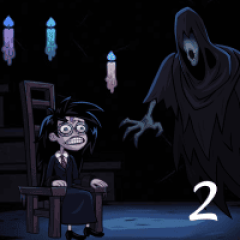
The story opens with a disorienting scene. Your head aches, your memories are fragmented, and the sound of a horse's footsteps suggests that you are being transported somewhere. As you regain awareness, you notice a pair of eyes watching you and hear an unfamiliar voice speaking nearby. The situation quickly becomes confusing. You do not know where you are, why you are there, or what happened before you woke up. The Jester, meanwhile, seems unusually familiar with your circumstances. His behavior alternates between irritating conversation and unsettling hints that he understands your predicament better than you do. This opening establishes the central mystery without immediately explaining everything. Instead, you are left to question the Jester's intentions while trying to reconstruct the protagonist's past.
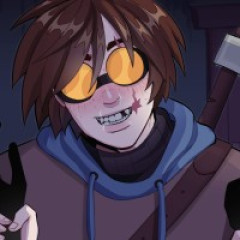
The Jester is the most important figure in the story apart from the protagonist. He is presented as an unknown supernatural entity who toys with the main character and attempts to persuade them to sign a contract. His personality creates an unusual contrast. He can be annoying, playful, and talkative, yet his actions carry a threatening undertone. The apparent humor does not eliminate the danger. It makes his intentions harder to read. As the story develops, the Jester's identity becomes more significant than his outward appearance suggests. He is associated with the Demons of Betrayals and Nightmares, and his role involves exploiting the protagonist's suffering to advance a supernatural arrangement. Understanding this character requires looking beyond what he says. His knowledge, persistence, and willingness to manipulate the protagonist reveal the power imbalance at the heart of their relationship.
One of the story's most important revelations is that the protagonist has died. Across the game's endings, the narrative establishes that a member of the protagonist's own family was responsible for the death. This discovery changes the meaning of the earlier scenes. The protagonist's confusion is not simply the result of an ordinary accident or a missing memory. Their encounter with the Jester takes place in the aftermath of a fatal betrayal, creating the foundation for the game's supernatural conflict. The revelation also gives the Jester a specific opportunity to exploit. The protagonist has suffered a deeply personal loss, and the possibility of revenge becomes a powerful means of persuasion. Rather than presenting revenge as an uncomplicated solution, the narrative connects it to a dangerous bargain. The protagonist must consider whether punishing the person responsible is worth entering an agreement with an entity whose motives remain questionable.
The Jester proposes a contract designed to persuade the protagonist to seek revenge against the person responsible for their death. His methods involve repeated persuasion, torture, and reincarnation, turning the agreement into a disturbing process rather than a simple exchange. The contract offers an apparent purpose to someone who has lost everything. Yet the offer comes from a supernatural figure who has already demonstrated his willingness to manipulate the protagonist. The promise of revenge therefore carries an important question: what will the protagonist have to surrender in exchange for it?
After the Jester succeeds in convincing the protagonist, the contract is signed, placing the protagonist in the devil's hands. This development reinforces one of the game's central ideas: desperation can make a dangerous offer seem attractive, especially when it appears to provide justice for an unforgivable act. The supernatural arrangement gives the story its emotional stakes. Revenge is no longer merely a personal desire. It becomes a decision with consequences that extend beyond the protagonist's original life.
The gameplay in Trapped with Jester focuses on storytelling and decision-making rather than complex controls, combat systems, or open-world exploration. As a short visual novel, it presents its narrative through written dialogue, visual scenes, and interactions between the main characters.
The primary activity in Trapped with Jester is following the story as it unfolds. Dialogue provides information about the protagonist's situation, while character interactions gradually introduce the themes of betrayal and supernatural manipulation. Because the protagonist begins with limited knowledge, each new detail can change how you interpret the encounter. A seemingly casual remark from the Jester may feel different once you understand his connection to the protagonist's fate. The experience is therefore less about mastering mechanical challenges and more about engaging with the narrative. If you appreciate visual novels that use conversation to build suspense, this approach gives you a clear reason to follow the story closely.
Decision-making is another important part of Trapped with Jester gameplay. The game contains four main endings and two alternate endings, giving you six endings in total. Multiple endings encourage you to consider how different decisions may affect the narrative's direction or interpretation. Instead of treating the story as a single fixed sequence, you can approach subsequent playthroughs with a greater understanding of the characters and their circumstances. The six-ending structure also gives the game additional replay value. After completing one route, you may want to revisit earlier choices and examine other possible outcomes. Each additional ending provides another opportunity to engage with the story's central conflict.
The available information establishes the number of endings but does not specify every individual ending title or the exact choice sequence required to unlock each one. For that reason, it is best to approach the branching structure as an invitation to explore rather than assume that a particular decision guarantees a specific result.
How to control: Left-click = Continue to chat with characters.
The narrative centers on two primary characters: the protagonist and the Jester. Their relationship drives the mystery, the contract, and the conflict surrounding revenge.
The protagonist is a member of the royal family of the Qualian Monarchy, also referred to as Qualia. Their royal background provides context for their identity, but the immediate problem is much more personal: they have died at the hands of a family member and are struggling to understand their situation. At the beginning, the protagonist's fragmented memory makes it difficult to determine what happened. This uncertainty places you in a similar position, forcing you to discover the truth alongside the character. The protagonist's predicament becomes even more complicated when the Jester offers a chance to retaliate against the person responsible. Faced with betrayal and the possibility of revenge, the character must confront a bargain that could carry consequences far beyond the original tragedy.
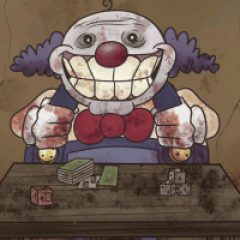
The Jester is an unknown deity who attempts to secure the protagonist's agreement to a supernatural contract.

Jester character in Trapped With Jester
He combines an irritating conversational style with a threatening presence, creating an encounter that is both strange and uncomfortable. His knowledge of the protagonist's past gives him an advantage, allowing him to control much of the conversation. Rather than offering straightforward help, he uses the protagonist's circumstances to make his proposal more persuasive. His connection to betrayal, nightmares, and the devil's contract places him at the center of the game's supernatural themes. The Jester is not simply a guide who explains what happened. He is an active participant in the conflict, with an agenda that shapes the protagonist's possible future.
One of the notable features of Trapped with Jester is its collection of six endings. The game includes four main endings and two alternate endings, allowing the narrative to extend beyond a single conclusion. The ending structure is particularly relevant because the story revolves around a contract with serious consequences. The protagonist's death, the discovery of familial betrayal, and the Jester's promise of revenge all contribute to the significance of how the story concludes.
The four main endings form the primary ending group. They are important to understanding the broader narrative because the protagonist's circumstances are closely connected to the Jester's attempts to secure the contract. The game's central conflict raises several questions worth considering as you explore its conclusions. How does the protagonist respond to betrayal? What does the promise of revenge mean when it comes from a manipulative supernatural entity? And what are the consequences of accepting an offer made under such desperate circumstances? These questions provide a useful framework for interpreting the main endings without assuming that every outcome follows the same path or carries the same meaning.
In addition to the four main conclusions, Trapped with Jester features two alternate endings. These expand the total ending count to six and provide further reasons to revisit the narrative. Alternate endings are particularly appealing in a short visual novel because they give you another way to examine the story without requiring an entirely different gameplay format. They also encourage closer attention to dialogue and decision-making. If you want to experience the game comprehensively, exploring all six endings is a natural goal. However, because the exact unlock conditions and individual ending descriptions are not established in the available information, specific walkthrough instructions should be verified against the game's own content rather than guessed.