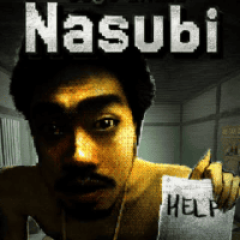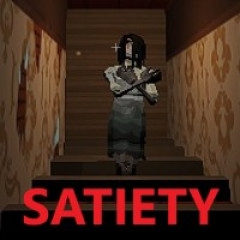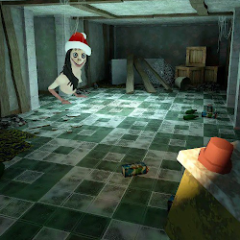
Nasubi is an epic horror game where you are placed inside an empty room. Use a rotary phone to enter lotteries, collect prizes, and uncover the dark mystery.
You are placed inside an empty room without the basic things you would normally take for granted. There are no comfortable supplies waiting for you, and there is nobody nearby to help. Your only tool for interacting with the outside world is a rotary telephone. That phone becomes the center of your existence. You use it to enter contests and lotteries, hoping that one of them will eventually provide something useful. Since you begin with no money, every successful prize can potentially change your circumstances. The concept of this psychological game is directly inspired by Susunu! Denpa Shonen, a late-1990s Japanese television experiment involving a contestant who was isolated and challenged to survive through sweepstakes prizes. The game takes that uncomfortable premise and turns it into a fictional psychological horror experience. Instead of simply watching someone endure isolation, you experience the routine yourself. Besides, you can take a look at Ayuwoki and Unlikely, which are also great horror games on our website.
The game wants you to experience the monotony of your situation rather than constantly distract you with new mechanics. The routine of dialing, waiting, receiving prizes, and figuring out what to do with them gradually becomes part of the psychological experience.
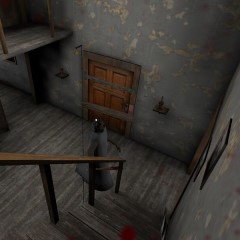
At the beginning of the game, you have zero dollars. Your first major objective requires you to reach $200, meaning you need to find a way to survive long enough to accumulate the necessary value through lottery rewards. You are also instructed to take off all your clothes before continuing. This immediately establishes how little control you have over the situation. There is no conventional inventory filled with helpful items. There is no comfortable starting area. You are simply placed in the apartment and expected to figure out how to survive. That makes even small improvements feel meaningful.
The rotary phone is more than a decorative object. It is the primary mechanism connecting you to the outside world. You dial numbers to enter contests, and each attempt creates another opportunity for something to arrive. The physical act of using an analog phone contributes heavily to the atmosphere. Rather than selecting a number from a modern menu, you have to interact with the rotary dial. The process takes time, and repeated attempts can feel tedious. However, the tediousness fits the premise. You are not supposed to feel like you have unlimited options. You are stuck with this one method of improving your circumstances. Every successful entry can therefore feel like a small moment of hope.
In a normal survival game, an item usually has an obvious purpose. You pick up food because you need food, collect materials because you need to craft something, or find equipment because it makes you stronger. Nasubi takes a different approach. A prize may be helpful, unnecessary, or simply strange. Because your starting conditions are so limited, even an apparently insignificant item can become worth considering. You are constantly evaluating what arrives and thinking about whether it can contribute to your survival. This makes the prize system more than a basic reward mechanic. It reinforces the game's central theme of uncertainty.
The objects you receive do not necessarily remain useless forever. The game allows you to recycle junk and use the resulting progression to gradually improve your situation. This creates a satisfying contrast with the deliberately uncomfortable beginning. At first, the apartment is almost completely empty. Over time, the things you receive begin to change your circumstances. Small upgrades provide tangible evidence that your efforts are working. The progression is incremental, but that is exactly what makes it effective. You are not suddenly given everything you need. Instead, you slowly build toward a more manageable existence.
Although the initial premise appears straightforward, Nasubi hints that there is more happening beneath its survival mechanics. The story begins with the idea that you have participated in a controversial television show and have now been left inside an isolated apartment. You are told what you need to do, but the situation itself raises questions.
These questions help give the game additional narrative momentum. The game's ending is one of the reasons it is worth continuing beyond the basic survival loop. The lore teased near the beginning and toward the conclusion suggests that the apartment and lottery system may be part of something larger. Rather than explaining everything immediately, Nasubi uses mystery to encourage you to keep going. This works particularly well because the gameplay itself is intentionally repetitive. The desire to understand what is really happening gives you another reason to endure the routine.
If you are starting this survival game for the first time, patience is one of the most useful qualities you can have. The game is built around gradual progress, so expecting immediate rewards can make the experience feel more frustrating than it needs to be.
Do not immediately dismiss an item simply because it looks useless. Your circumstances are unusual, and the value of an object depends on what you currently need. Keep track of what arrives and consider whether it can contribute to your progression.
The rotary phone can become repetitive, especially when you have to keep entering contests and waiting for results. However, this is an intentional part of the design. The repetition helps communicate the psychological endurance aspect of the game. You are meant to feel the passage of time and the monotony of your isolated existence. Instead of rushing through every action, pay attention to how the routine changes as your situation improves.
Because Nasubi has a non-linear structure, you do not necessarily have to approach every situation in exactly the same way. Experiment with available systems, examine your rewards, and look for opportunities to improve your circumstances. The game is designed around discovering how to survive with extremely limited resources.
Nasubi turns an unusual survival premise into an atmospheric psychological horror simulation. You begin with nothing: no money, no clothes, no supplies, and no human contact. A rotary phone is your only connection to the outside world, and lotteries are your primary opportunity to obtain what you need. From there, the game builds its experience around waiting, uncertainty, recycling, upgrades, and gradual survival. What makes Nasubi stand out is that its horror does not depend entirely on traditional threats. The empty room, repetitive phone calls, unpredictable prizes, and lack of human contact are enough to create pressure. If you enjoy psychological horror, unusual simulation games, retro-inspired visuals, or experiences built around strange experimental concepts, Nasubi offers a memorable take on survival. Your objective may begin with something as simple as reaching $200, but the deeper you go, the more the game encourages you to question the situation you have been placed in.